The Men Whom the Church Delights to Honor

Key leaders of the Brethren Church at the 1883 Dayton Convention; Photograph at the Brethren Church Archives, Ashland, Ohio.
It was the year 1920. Thirty-eight years had passed since the forefathers of the Charis Fellowship were ousted from the historic church they loved (1882) primarily because of their passion for the Gospel, their commitment to the Great Commission, their disdain for legalism, and their embrace of innovative ministry methods to reach more people for Jesus. As editor of the weekly publication ‘Brethren Evangelist’ in 1920, George S. Baer penned the following stirring tribute:
January 28, 1920. There are certain men who stand out above the rest in the mind of the church as deserving of honor. They are the men who blazed the way for the Brethren church [Charis Fellowship] as a separate and distinct denomination. They are the pioneer ministers of the church, the men who wended their way alone over the mountains, through the woods and across the prairies to preach the simple Gospel of Jesus Christ without addition or subtraction and to build up little groups of worshipping saints in every community they might enter. They are the men who fathered the denomination, which stands not for the promotion of a new “ism” or creed, but for the restoration and propagation of the primitive Gospel and the practices of the primitive church. They were noble men, God-fearing men, who opposed the requirements and prohibitions of men as much as they loved the laws of God. They were such men as God gives to be the pioneers of a great movement; men in whom certain challenging virtues stand out in bold relief.
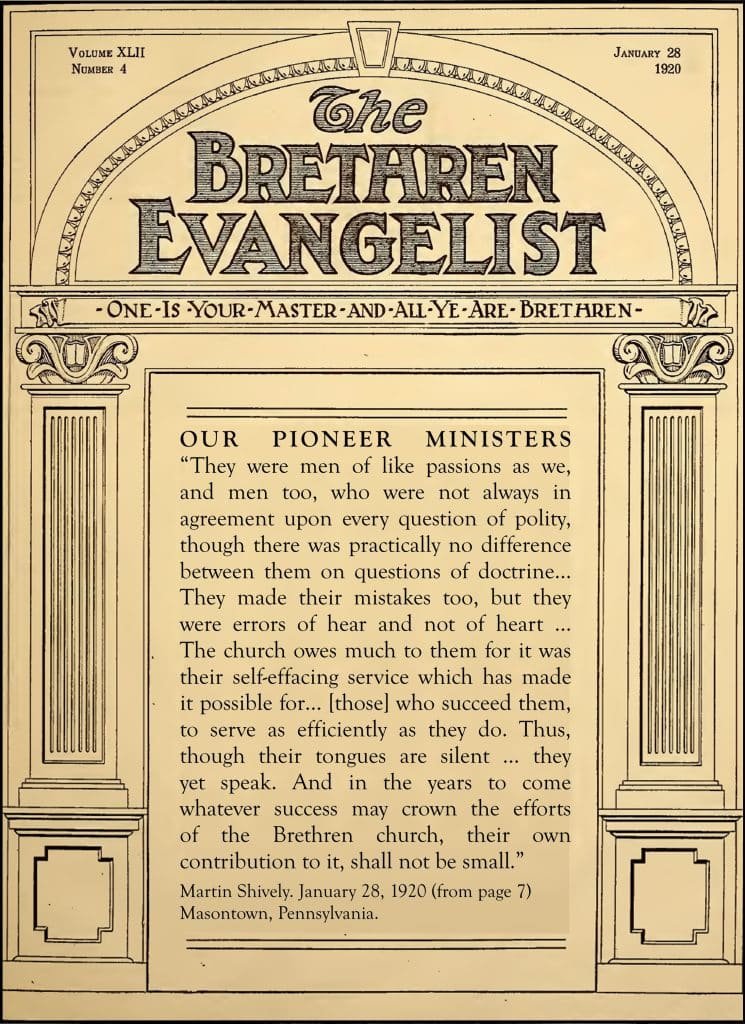
The Brethren Evangelist cover from January 28, 1920
These men were men of conviction. They believed strongly in the Word of God and its sufficiency for man’s salvation and growth in grace. They would allow nothing to be either added or subtracted from the Book of Life. It was their rule of faith and practice, and Christ the Head of the church was their great exemplar. What He taught by precept or example it was theirs to obey. They believed so strongly in this course that they would die rather than give it up.
They were men of courage. They would neither shrink before ridicule nor falter before bitter denunciations or condemnations. When a course was clearly right to them they would undertake it though excommunication would be their reward. Their courage consisted not of reckless daring or a hazarding without fear, but of a firm resoluteness in a just cause. Their sense of duty held them steady in the course they had chosen and would not permit them to turn back.
Here conviction and courage went hand in hand. Conviction gave the reason and courage supplied the determination. When once they had taken their stand according to their conviction, they would “stand fast” and would not be moved. They might be persecuted for it, nevertheless they would “stand like a beaten anvil.” They were men in whose lives sacrifice was a large and essential part. Their very calling required it. No one ever pioneered a great cause, especially such as the purification and restoration of primitive Christianity, without experiencing sacrifice in a large way.
And these pioneer preachers knew what sacrifice meant. They considered not the goods of this world, as things to be prized, which many might have had in generous portions, in order that they might preach the Gospel and turn men from ignorance and sin unto light and salvation. They gave their time freely, not even claiming the hire concerning which the Scriptures says they were worthy, that the kingdom might be preached and the church might be established in needy places… These pioneer Brethren did not seek to avoid sacrifice; they made it cheerfully; it was to them the measure of their devotion.
They were lovers of freedom. They loved so much “the freedom wherewith Christ hath made us free” that they refused to be “entangled again in any yoke of bondage.” To avoid it they would make any sacrifice. When the undivided Israel began to add mandatory decrees to mandatory decrees so that their liberty of conscience was taken away, they parted company with their comrades in Christ. Many friendships were broken, many lives were disappointed, and many futures were clouded because of the rent in the brotherhood brought about by the Gospel to deprive men of their religious freedom.
The Gospel is the fundamental principle of the Brethren church. Recent conversation with some who went through that most unfortunate experience in the history of the Brethren fraternity have elicited this unanimous statement, namely, “The liberty for each individual to read and interpret the New Testament scriptures under the guidance of the Holy Spirit was the issue at stake.” They loved the freedom which Christ gave. To have it they were willing to sacrifice all that an otherwise desirable fellowship would mean to them, for they knew that if Christ should make them free, they should be free indeed.
Though they were men of great conviction and courage and though they were strong enough to make any sacrifice and loved freedom passionately, yet they were men of charity and consideration. They had their differences as we today have ours, but they exercised charity one with another. They had not failed to receive instruction from the Apostle Paul who wrote to the Corinthians that however great their devotion and sacrifice might be, it was all for naught if they had not love. That great apostle himself was as strong and unflinching for the right as the rock ribbed hills about him when he wrote, but the granite of his nature was covered with flowers. He was stern in morality, Cromwellian in courage, but Christlike in tenderness and sympathy. The strongest are always the tenderest.
And we see in the strongest of these pioneer men of the church a charity maturing with the growing strength of their trying years. Out of their trials they learned forbearance… These men were not gods, but human beings, with our common weaknesses and possibilities, temptations and aspirations, but in the trials of their faith they found their strength in Him whom all the powers of darkness were impotent to overcome. The testings of those pioneer days of the church made them strong and noble and the message of their peerless lives will not pass with the number of their years. Such are the men whom the church delights to honor.
This editorial article was written by George S. Baer and was originally published in the January 28, 1920, edition of The Brethren Evangelist, Volume XLII, Number 4, Page 2. The Brethren Evangelist was the newspaper magazine of the Charis Fellowship from 1883 until 1940 when the Brethren Missionary Herald magazine was established. Researched and edited by Tim Hodge for the Year in Review 2024–2025. Tim serves as the Charis Fellowship Coordinator.
Posted in Brethren Digital Archive, Charis Journal, News
