Collaboration in Hermosillo (Mexico)
The state of Sonora covers a vast territory in northwestern Mexico. It is home to several thriving Charis Alliance churches and an active Bible institute. However, most of these churches are concentrated near the Mexico-U.S. border, while the largest population center is located eight hours away by car, in the city of Hermosillo, which is the state capital.
Hermosillo is the largest city in Sonora and serves as a major industrial, economic, and agricultural hub, with a population of over 936,000 in 2020. Known as the “City of the Sun,” it is famous for its warm desert climate, its proximity to the beaches of Kino Bay, and its manufacturing industry (particularly the Ford Motor Company).
The following interview with Pastor Edgar Cruz tells an inspiring story of collaboration and interdependence, as the Charis churches joined together to plant a church in Hermosillo.
1. What has your experience been like in church planting, and what are you currently doing?
Answer:
When I first began in ministry, I was only focused on establishing a church. We were discipled by great mentors, great teachers—mostly Americans—and we continued that ministry.
So when I arrived at the church 33 years ago, I dedicated myself to building a strong church. But when I started attending conferences, the first thing that caught my attention was the topic of Total Mobilization that some brothers shared.
It was then that I began to open my eyes a little, to understand that the Lord’s work is not only within our church but also outside the church. From that moment on, God began to change my life, to turn it around, to lift my eyes and look beyond our walls.
Before, the idea was: one church sends someone, and that church supports them. But the other churches do not feel like they are part of it. So we started working on a project where we could include all the churches in the founding of a new ministry, so that everyone could participate, feel the burden, pray, and support.
2. What concrete steps did you take to start the ministry in Hermosillo?
Answer:
First, we spent a year in prayer. Throughout 2021, I shared with the church the desire I had in my heart to start a ministry in Hermosillo. I also shared it with some pastors and brought it up at the conference. I told them: “Brothers, we want to start a ministry; pray with us.” That was the first step.
Then, in 2022, we began working. Every month I traveled to Hermosillo, an eight-hour drive. The first time I went with a team of about eight people to a house where we had a contact.
That very same day, the husband of one of the people there accepted Christ. And that was the house where we started the ministry.
After that, I kept going every month, teaching them and the neighbors, and each month I brought a different couple from our church to see who felt a burden for that place.
Until I brought Carmelo and Teresa. When we returned, I said to him, “Brother, I want you to go to Hermosillo for a year.” And he said to me, “I’ll go; let me get my things in order.”
On January 13, 2023, we sent him with his family. We rented them a house next to where the ministry began, and he is still there to this day.
3. What model do you use for church planting, and why?
Answer:
We do not send just one person. We send a team. In the past, we used to send just one person, and I saw that they suffered from hunger. The churches were poor and there were many problems.
So I said: I do not want the missionaries we send to suffer the same fate.
That is why we started working on a model where we send teams—people who already have jobs, stability, and can support themselves—and that helps the church grow faster.
For example, a church we planted earlier was self-sustaining within two years. It grew quickly because we sent a team, not just one person.
4. How do other churches get involved in this project?
Answer:
When we presented the project at the conference, we said: ‘We already have a pastor, we already have a place, we are sustaining the work.’
Then three churches joined in to financially support Brother Carmelo.
But not only that. There are different teams that go throughout the year:
Our group consists of 25 to 30 people; we hold festivals for children, games, meetings, and provide food, clothing, and toys
Another church runs programs with children
Mission teams go to conduct evangelistic campaigns
The churches understood that this is not the work of a single church, but rather the work of everyone.
5. What are the current challenges facing the project?
Answer:
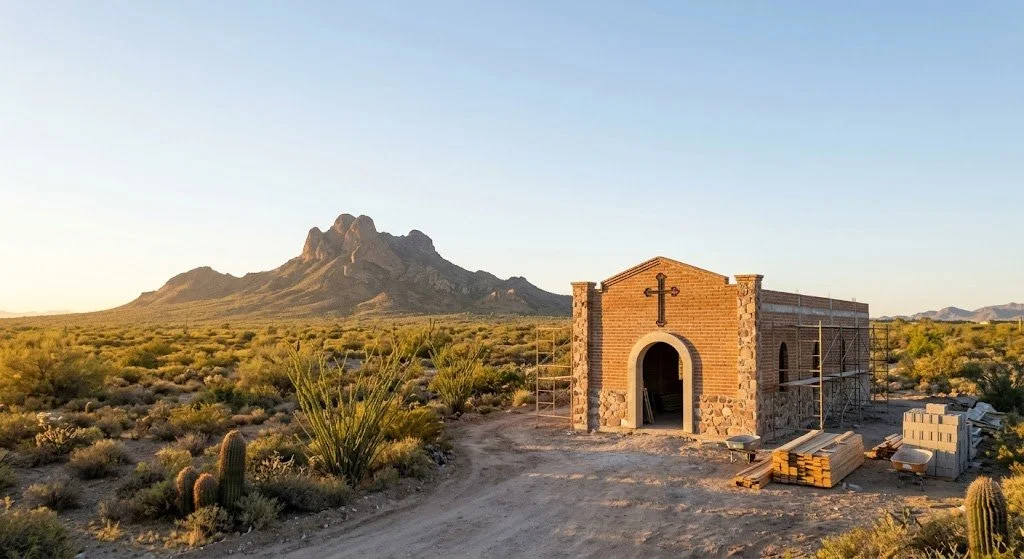
Thank God, the project is further along than we planned. We thought it would take 4 or 5 years to build, but we have already purchased the land and started construction.
The challenge now is to finish the meeting place. We have received offerings, but they are not enough.
Right now, we are in a makeshift wooden church. But people in Mexico want to see a church building. People do not easily go to a house.
On top of this, the space currently in use will be affected by a government construction project, so we need to move quickly.
6. What challenges do you face personally as a leader?
Answer:
The biggest challenge is encouraging Brother Carmelo. He comes from a large, established church with many things he does not have here.
Sometimes he tells me, “I need a worship team; I need a better place.”
I tell him, “Brother, all in good time; God will give it to you.”
My job is to visit him, even if it is just to have a meal with him, to listen to him, pray for him, and encourage him so he does not get discouraged.
7. How do you prepare leaders to be sent out?
Answer:
We have two ways:
First, the Bible Institute. Students apply and enroll. There we see who has the calling and the ability.
Second, internal training in the churches.
We as teachers observe who has the capacity for leadership. We give them more attention and open up opportunities for them.
Sometimes I see someone myself and tell them, ‘You don’t belong here; you need to go and start a ministry.’
That is how we guide people according to the calling God gives them.
8. Why is supporting the missionary so important?
Answer:
Because it is difficult for a worker to go to a place without financial support.
If the pastor must work to make ends meet, he comes home tired and has no time for ministry.
A missionary must be 100% dedicated.
That is why our church supports him and other churches help. The idea is to support him for 2 or 3 years, and then for the new church to grow and sustain itself.
A part-time missionary does not work. The ministry either does not grow or disappears.
9. How do you achieve good interdependence and collaboration between churches?
Answer:
There is a saying here: ‘You get what you give.’
First, we must teach the heart of God for missions. Many pastors are still focused only on their local church.
Then we must show results. When they see results, they get excited.
They say, ‘If they could do it, so can we.’
Then we tell them, ‘You too can send a missionary and support them.’ That is how collaboration arises.”
10. How do you maintain communication between churches and teams?
Answer:
We have many activities: men’s, women’s, and youth meetings, camps, and conferences.
We also bring Brother Carmelo to share what is happening in Hermosillo.
We invite him to preach at other churches and participate in camps. He brings young people and shares testimonies.
That way, everyone learns about it and connects with the work.
11. What advice would you give to churches that want to collaborate in church planting?
Answer:
Break down the barriers.
Do not say, ‘This is my church, this is my work.’
The work belongs to God.
If churches stop thinking individually and start working together, they can accomplish much more. That is the main advice.
Conclusion (with emphasis from Edgar)
“We must look beyond the walls”
“Don’t send just one person, but teams”
“The missionary must be 100% dedicated”
“Showing results motivates others”
“Break down barriers between churches”
